|
|
-hardx- Bridgette B- Steve Holmes - Prime Milf ... [upd] < Trending – Review >
Historically, the cinematic landscape treated aging as a liability for women while celebrating it as "distinguished" for men. Early Hollywood legends frequently saw their leading roles dry up in mid-life.
The series has been so successful that it has run for multiple volumes. For instance, continues to be a sought-after collector's item, praised for bringing "the essence of mature, erotic beauties" into focus. By the 8th volume, the series was a high-profile enough project to feature rising star Casca Akashova as its cover model, further cementing its status as a premier showcase for top-tier talent in the MILF category. For any performer in the industry, appearing in Prime MILF signifies being at the top of their game in the mature performer space. -HardX- Bridgette B- Steve Holmes - Prime Milf ...
The historical marginalization of older women in film was often blamed on the "male gaze," which prioritized youth and conventional beauty over depth and experience. This created a vacuum where actresses like Meryl Streep were considered anomalies rather than the standard. Today, the narrative has changed. Streep remains a titan, but she is joined by a powerhouse cohort including Viola Davis, Michelle Yeoh, Cate Blanchett, and Jennifer Coolidge. These women are not just participating in cinema; they are dominating it, winning Academy Awards, and anchoring billion-dollar franchises. Historically, the cinematic landscape treated aging as a
Explore the powerful renaissance of mature women in entertainment and cinema. From Nicole Kidman to Michelle Yeoh, discover how seasoned actresses are breaking stereotypes, producing their own stories, and dominating the screen. For instance, continues to be a sought-after collector's
Furthermore, the conversation around mature women in entertainment has expanded to include diverse perspectives. Actresses like Angela Bassett and Michelle Gomez are challenging both ageist and racial stereotypes, proving that "fierce" and "commanding" are traits that only sharpen with time. This inclusivity is vital, as it reflects a world where women are leading corporations, governing nations, and redefining what it means to be a "leading lady" in their daily lives. |
|
|
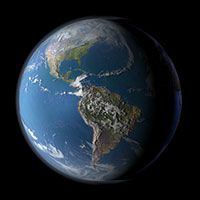
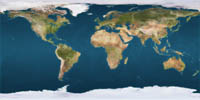
This map is a synthesis between my original earth map, gradient mapping of the USGS DEM information, hand painting, DEM modulation of detail, bathyspheric depth information, and the USGS Ocean clip. Bathyspheric data was used to modulate the color of the water so that deeper areas are a darker blue than shallow areas.
|
|
|
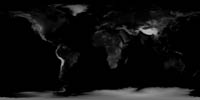
This is pieced together exclusively from the USGS DEM database. It contains landmass elevations only, with the ocean at zero, and the top of Mt. Everest at 255. Use this as a bump map to give the appearance of the Earth's rugged surface features. Some madmen have also used this data in POV Ray as a displacement map on a very finely divided sphere to produce a "true" 3D version of the Earth. The 10K version is VERY large, so make sure you really need that much detail.
|
|
|
This is derived from USGS DEM data, with the addition of the Arctic ice areas which do not show up on USGS data (since they are not solid land masses.) Use this to control specularity and reflectance of the ocean surface.
|
|
|
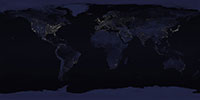
1024 x 512 color image. Very similar to the night lights map as published by NASA on their Blue Marble Page. I took their
30000 x 15000 black and white city lights map, and adapted it with a color table to a colorized version of my earth color map. This comes in 2k, 4k, and 10k versions in color, as opposed to the maximum 2k size of the NASA version of this map (higher resolution versions are available on the paid page only because of their size).
Be sure to have a look at the tutorials page for a special rendering tip for using this map. |
|
|
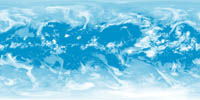
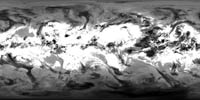
1024 x 512 color image. Based on a mosaic of satellite data, colorized, data errors retouched out, and fixed for seamless wrapping.
|
|
|
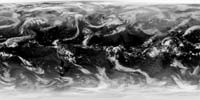
1024 x 512 greyscale image. Based on the same data as the color map, but leveled for the purpose of transparency mapping.
|
|
|
4096 x 2048 greyscale image. Built up out of real satellite imagery based upon a tutorial Dean Scott of Silicon Magic has posted. This is posted in JPEG2000 format. You need a special Photoshop plug-in to make use of jp2 images. I've thoughtfully provided a link:
JPEG 2000 Plugin from Fnord.
|
|
|
-hardx- Bridgette B- Steve Holmes - Prime Milf ... [upd] < Trending – Review >
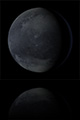
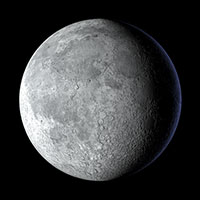
The Moon is a tricky planetoid to render. It has a very distinctive albedo which remains constant across its lit side, regardless of the angle of the surface to the sun. Therefore, standard rendering lighting models do not apply, as they always have a characteristic drop off in intensity as the angle of incidence to the light source increases. In Lightwave, there is an option to use a "non-Lambertian" lighting model on a surface setting. In previous versions of Cinema4D, you had a contrast control in the lighting setup. More recent versions of Cinema4D feature an Oren/Nayar illumination model in the lighting setup which allows you to simulate the lighting properties of "rough" surfaces. This is the method I used on the same pictured here.
|
|
|
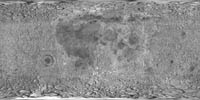
This map is based on a mosaic of satellite data, retouched for visible mosaic seams and for problems with the wrapping seam. Since this image contains highlight and shadow information independent of the location of your light source (inevitable because of how the moon is illuminated by the sun), you'll need to be careful how you light this so you don't break the illusion.
|
|
|
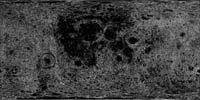
This map is my attempt to derive bump information from the above map. I did a high-pass filter operation to find all the edges of the craters, and then curved the result so that blacks and whites were white, and mid-tones were black. The results came out pretty well, as you can see from the sample image above.
|
|
|
|
|
|
this site works
best on Firefox:
|
|